Religious

Jumu'ah

Organizing on-campus Jumu'ah prayers is a great responsibility, a prayer that is fard upon every Muslim male. Ensuring each khutbah is authentic, upon the Qur'an and Sunnah, and free of innovation is a heavy burden; ask Allah to assist you and renew your intentions.

Day-by-Day Breakdown

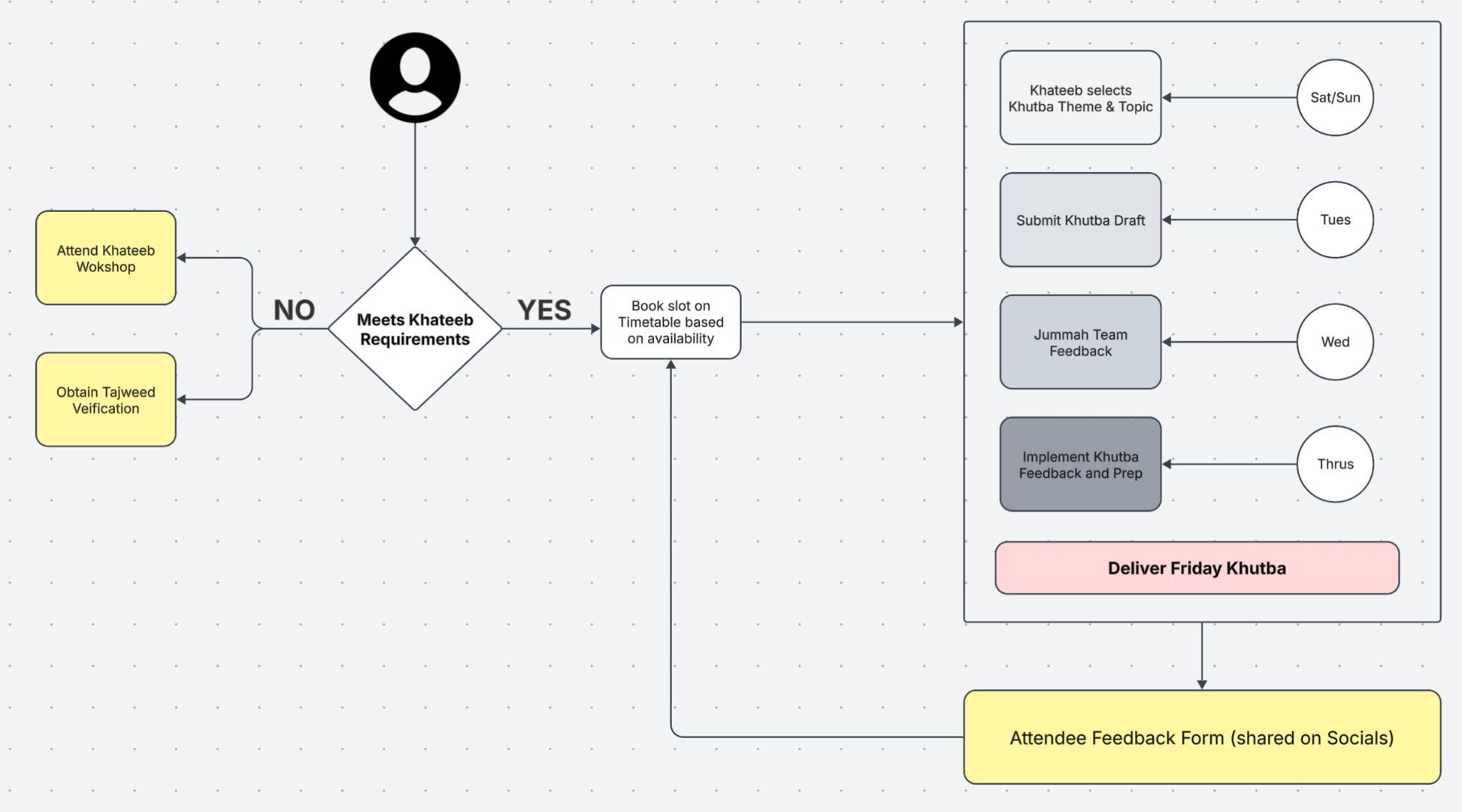
Flowchart of the Jumu'ah process from khateeb requirements through the weekly schedule to the Friday khutbah and feedback form
Overview of the Jumu'ah workflow: khateeb requirements, the Sat–Thu schedule, delivering the Friday khutbah, and the feedback form.

Saturday / Sunday

  • Determine which Jumu'ahs will be held on campus. Generally all 3 are held, but in special cases (between terms, near final exams) consult with the Education Team.
  • Find khateebs for the upcoming Jumu'ah (MSA Khateebs Chat).
  • Once found, reach out to each of them and gently refresh them on the deadlines. Khateebs must meet the Khateeb Requirements found further below.
  • Suggest some topics that have been recommended through the feedback form.

Tuesday

  • Ideally the khateebs should have their rough drafts done by Tuesday.
  • If they're not done, give them a heads-up.

Wednesday

  • Review the rough drafts by Wednesday night at the latest.
  • Reviewing these drafts is one of the most important parts of this role, the responsibility of what is said at khutbahs somewhat lies on your shoulders. See the Draft Review Process below.
  • Put out a poll in the volunteers chat for Jumu'ah support (ideally primarily leads volunteering).

Thursday

  • Reach out to the khateeb, letting them know you're done with the review process and they can check their draft and implement feedback.
  • Clearly point out anything of major concern.
  • Update the Jumu'ah Announcements Doc (it's your job to come up with these).
  • Ask the 1:30 khateeb to arrive 10 minutes early and put out the pylons for segregation and the sign directing where to put shoes.
  • Ask the 3:00 khateeb to put those two things away when done, send picture evidence.
  • Make sure marketing posted the Jumu'ah post with the correct info.

Friday

  • Once the Jumu'ahs are completed, marketing will post the feedback form.
  • Record a quote for "Jumu'ah Jewels," per khutbah.
  • At the end of Friday (so all responses are in), review the Khutbah Feedback responses and reach out to each khateeb with their relevant feedback.

Other Important Points

  • At the beginning of every term, a new Khateeb Schedule must be created and maintained, copy the Khateeb Schedule (Sample). It has an Instructions tab (khateebs read and follow these), a Schedule tab (khateebs fill out the relevant fields), and a Khateeb Approval tab (the Jumu'ah lead maintains a list of khateeb statuses).
  • Make sure the Khateeb Schedule is updated as the process goes. This is the sheet that links marketing, finance, education, and various teams regarding Jumu'ahs, it is your responsibility to keep it updated.
  • Structure WhatsApp messages well. People read and internalize a well-formatted message better. Use bolds, italics, spacing, and emojis well.
  • Communicate with khateebs regularly and appropriately. Khateebs are students too, with courses, tests, exams, and assignments. Balance understanding their other priorities with ensuring they aren't consistently missing deadlines, and always speak in the most respectful and well-mannered tones. If you have concerns about a particular khateeb, reach out to the VP to discuss.

Khateeb Requirements

For anyone to khateeb, they must meet 2 criteria:

  • Tajwid approval by the Tajwid teacher. Refer to the Khateebs Spreadsheet or ask them directly if they've been Tajwid verified, we do not allow anyone to khateeb without this prerequisite. If they say they're verified but aren't on the spreadsheet, update the sheet. Anyone interested in getting Tajwid verified should message the Tajwid teacher or (recommended) attend Tajwid class where he can test/verify them at the end.
  • Attended a Khateeb Workshop (in any term). Refer to the spreadsheet or ask them directly. This is also a prerequisite; update the sheet if needed.

Draft Review Process

Once the khateeb has submitted their draft by the Tuesday/Wednesday deadline, make sure their Google Doc allows commenting. Use Google Docs commenting on the same doc linked on the schedule so anyone on the team can review the draft and your reviews. Use comments to highlight parts of the khutbah that may fall into the following:

  • Presence of evidence. Whenever the khateeb makes an Islamic point, there should be evidence from the Qur'an and Sunnah to back it up. Question the source of their ideas; if they make it up, that is usually not a good sign.
  • Lack of source/reference. All ahadith should be quoted with their grading and the book they're from, and scholarly sayings correctly attributed.
  • Inauthentic. Da'if hadith should be avoided to prevent confusion.
  • Problematic views. While we should not be shy to say the truth, some things should be handled with hikmah, aware that there may be new Muslims in the audience.
  • Inappropriate content. Jokes should be avoided; the khutbah addresses the Muslim ummah, it is not standup. The Prophet ﷺ used to be serious during his khutbahs [Sahih Muslim 867].
  • Feedback on delivery. Where possible, give feedback on delivery to make the khutbah more engaging, e.g. "Emphasize this statement," "Smile for these parts about Jannah," "Show sternness when forbidding certain acts."

A Helpful Resource

See Fiqh of Jumu'ah for background on the rulings surrounding the Friday prayer.